Friday, February 18, 2022

Nickel has infant # 5!

 Fongoli female Nickel had her fifth infant in January 2022 - the first baby of the new year! Nickel is one of the few females that remained within her natal group. Nickel's mother was Nene, an older female that disappeared a few years ago. Nickel's younger sister, Nellie, did transfer out of the Fongoli group and is thought to have at least passed through the neighboring Bantankilin chimpanzee community to the west of Fongoli. 

Nickel's previous infants include female, Teva, males Vincent and AJ and daughter Aviv. Nickel has the shortest inter birth intervals of any female at Fongoli, sometimes as little as 2.5 years between successive births. 

Congrats Nickel (& us too!) - pant hoots! 

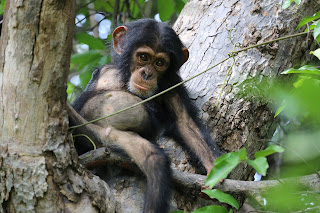
(image is of Vincent when he was an infant) 


Friday, May 15, 2020

It's been a long time since we've updated you on the Fongoli chimps, but everyone is still doing well! You can now get the DVD of the BBC's Dynasties documentary series that features the chimps in one episode. Here is a link to a nice overview of that episode via photos:

Live Science Fongoli Chimp Photo Story

In other news, we have had a couple of new infants, from Eva (girl, Ella) and Lucille (boy, Zeb), and the group remains stable in light of the ongoing gold mining in Senegal.

The Fongoli research team is minimizing contact with the chimps during the Covid-19 pandemic by doubling our conservative follow distance (distance between us and the chimps) from 10 meters to 20 meters. They are continuing to follow the group members to keep tabs on their health and locations.

Our associated Neighbor Ape organization is funding a mask-making project via a local tailor in Kedougou, Senegal. So far, we have been able to fund the sewing of 300 masks, and these will be distributed in the villages of Fongoli, Petit Oubadji, Djendji, Tenkoto, Ngary, and Ngary-Seekoto.


Finally, one of the oldest adult male chimpanzees at Fongoli - Bilbo - has not been seen in several months. We hope that he returns. Bilbo is pictured in the photo above, carrying several baobab fruit during the dry season at Fongoli. One of our Neighbor Ape fundraising projects currently features this photo of Bilbo. Follow this link to the Fongoli Chimps Store at teespring to see more:

Fongoli Chimps Store on Teespring


Wednesday, November 7, 2018

Fongoli Chimps To Be Featured On the BBC's Dynasties Series! 

Narrated by Sir David Attenborough, this series follows different animals as they struggle with their own dynasty...


Dynasties airs, with Chimpanzees being the first episode, on November 11 in the U.K. 

Here are some links to the video trailers!


Former alpha male David is the star of the Chimpanzee episode, which features the Fongoli chimpanzees. 


The series will air in January in the USA... (photo of David courtesy of the BBC)


See if you can ID some of the Fongoli chimps in the film!


Sunday, August 19, 2018

We've published various manuscripts about the Fongoli chimpanzees over the last year, but one by former Iowa State student and current Ph.D. candidate at Max Planck Institute, Erin Wessling, garnered the interest of the New York Times!  You can read the story here:

Fongoli chimps in the NY Times

In other news, Fongoli chimpanzee Lily had a daughter in May, and she is doing well. Her name is Annie, and you can see how cute she is in these photos by Iowa State University graduate student, Nicole Wackerly:


Wednesday, October 11, 2017

Farewell to Mboule Camara


This summer we lost someone that, if I can quote a former student and friend of mine (Dr. Michael Waller) was “one of the great characters of my life”. Mboule Camara died in late June 2017. He was born in Maragoundi, Senegal in the 1940s. I met Mboule in the year 2000, when I first traveled to Senegal to conduct a survey of chimpanzees in this savanna habitat. I was introduced to him by Peter Stirling, also a key part of the Fongoli Savanna Chimpanzee Project. Without Peter I would not have met Mboule and without Mboule, I don't think the Fongoli Project would have ever materialized. We rolled on up to Fongoli and asked a bunch of men under a Saba tree if anyone would take us out “en brousse” (to the bush) to find chimpanzee nests. Mboule said he would. He was my first field assistant and my guide to the wonderful world of Fongoli.

 
Since Mboule passed away, I have thought a lot about what I might write, when it was not as painful to write about this unique man. There is too much to write, in fact. And, many of the stories that I love about Mboule and I know that others love might make him seem too much of a funny or comical figure to those who didn’t know all aspects of the man. So, maybe I won’t write about some of those moments, no matter how endearing they are to me. Maybe I will ask those who knew him to have a private conversation on one of the many messaging platforms we have these days, where we can reminisce about the funny stories we have to tell about our times with Mboule. Because there was so much more to him than that.


One thing that I do want to write about though is something I heard at his funeral. Or, more specifically, at the sacrifice (we’d say memorial in the U.S., I think, or feast or maybe even wake) held in his honor three days after he passed. (I actually missed Mboule’s funeral, as I was out following chimpanzees and didn’t get my messages until the end of the day when I reached a high spot where my cell phone got a signal. He had died early in the morning and was buried before noon. Missing his funeral is one of my great regrets in life.)

 
I understood virtually nothing that was said at the sacrifice, as most of it was in Malinke, Mboule’s first language. My project manager, Dondo Kante – and Mboule’s longtime friend – translated some of what was said to me. He mentioned the only woman who had gotten up to say something about Mboule. Everything else was said by men. She was crying as she spoke, which brought tears to your eyes, regardless of the fact that you couldn’t understand her. Dondo told me that she related the story of how Mboule helped her with finances while she searched for a place to live, and she talked about what a big heart he had. Many of the things people said were along these same lines. Most people I know from the United States would think that Mboule was a very poor man; yet he helped others and he always put his family first. He was about as genuine as they come.

 
Mboule was my first field assistant and guide at Fongoli. He revealed a lot to me about the chimpanzees and he learned a lot too. He laughed when I told him chimps ate termites, and I saw him years later schooling students on how chimps ate termites. He told me that chimps used caves, and many primatologists – and others – found this fascinating. Without Mboule, it would have taken me years to discover this. He took me all over the Fongoli range that first year, to the point that I didn’t want to look for another chimpanzee nest. I’d written data on hundreds of nests on one of those days, only to follow Mboule a little more and have him stop and point up to yet more nests. He knew that “bush” like the back of his hand. He had a GPS built into his brain. He could beeline it straight home from anywhere in the 100km area we found the Fongoli chimps using – and he could do it at night. He’d run after me when we were chased by angry bees, hitting them out of my hair so that only he was stung. He helped me bury our dog, Nyegi, something I’ll bet he never imagined doing in his life – and I doubt many of his friends and family would have believed it either. He introduced me to the cultures there, and he was responsible for making it possible for me to work in Fongoli.


Mboule retired some years ago – at least from guiding students and following chimpanzees. (Although he danced so much at our 10th year anniversary of the project that I wondered why the man was retired!) But, we’d always talk about the chimps when I got home from following them. I’d pass by his compound on the way to ours, and he would always ask me if they were in a large group and where they had nested. Then we’d discuss whether that was near or far, what they were eating and if they had caught any monkeys or bushbabies. He’d continue to ask about some chimps that were no longer in the group, but I never had the heart to tell him they’d disappeared. He helped out with orphan chimpanzee Toto and was always eager to learn news of him, even after he went to sanctuary in Guinea. I think that’s one of the things I’ll miss most about Mboule. Those conversations that weren’t even in very much depth because of our language barriers. Still, they meant so much to me, as did Mboule. I will miss him greatly. 


(With thanks for photos to Erin Wessling, Maja Gaspersic, Clayton Clement, & Stephanie Bogart)

Saturday, September 10, 2016

Fongoli chimpanzees featured in New Scientist video clip


New Scientist editor Rowan Hooper recently talked about Fongoli chimpanzees' hunting behavior, and part of the story is featured in this video clip:


An invited presentation at the Chimpanzees in Context symposium by Dr. Stacy Lindshield in August of this year provided an update on the spear-assisted hunting behavior practiced by Fongoli chimpanzees. http://www.chimpsymposium.org/

Another invited presentation (courtesy Dr. Fiona Stewart and Dr. Niki Tagg's symposium on apes' nocturnal behavior) at the International Primatological Conference, which was in conjunction with the American Society of Primatologists conference this year in Chicago, following the Chimps in Context symposium also previewed research on the Fongoli chimps' nocturnal behavior. https://www.asp.org/IPS/meetings/abstractDisplay.cfm?eventNumber=&expand=false&abstractID=6401&confEventID=6484&parenteventid=6484


Look for upcoming publications in the near future on this as well as other topics at Fongoli including lethal aggression and the chimps' reactions to snakes and other reptiles!

Tuesday, February 16, 2016


It's been a long time since we last posted here, and a lot has happened at Fongoli. The community is doing well and is up to 33 individuals. There are a number of new infants, and we expect Natasha to give birth soon. She is currently traveling alone with her brother (Diouf, shown in the photo above, taken by Fongoli Project Manager Dondo Kante) and her older infant, Pistache (who received his name via a Leakey Foundation donor/auction, and we think Louis Leakey would probably like this chimp a lot!).

In other news, we published an update (We're actually over 350 cases now!) on the tool-assisted or "spear" hunting behavior exhibited by the Fongoli chimps last year in the journal, Royal Society Open Science. We confirmed our earlier findings that females hunt in this manner significantly more than males, although there is no sex difference in hunting success.

The article is free and here is the link:

http://rsos.royalsocietypublishing.org/content/2/4/140507

Orphan Toto is still under our care (Janis Carter and the Foundation for West African Chimpanzees and Friends of Animals and our own Neighbor Ape organization). We are hoping to place him soon with other chimpanzees and in anticipation of this, we have started a fundraiser to help build facilities for the sanctuary he will (hopefully!) be going to.

This link provides some information about this:

https://www.youcaring.com/neighbor-ape-nonprofit-organization-519491


The BBC is currently filming at Fongoli, and another BBC documentary is in the works based on filming conducted a couple of years ago, so you will be able to see the chimps again in a couple of new documentaries. Look for some really interesting behaviors - of course! Stay tuned for updates, and I'll try to be better about keeping up with this blog!

Monday, October 27, 2014

Fongoli chimpanzee 2015 calendars available! New report about Neighbor Ape projects in Senegal, Fongoli chimps on BBC & Eva's first infant!

Our first round of sales of the 2015 Fongoli chimpanzee calendars went so well, we are going to put in a second order! These calendars feature the adult males of the Fongoli group this year, as well as rescued orphan Toto. Each calendar is $15 (which includes shipping & handling to anywhere in the world), and your purchase of a calendar also means we will buy a second one to be given away in Senegal as part of our education efforts. If you are interested in a calendar (or two!), you can mail a check or money order to Neighbor Ape, 1216 Burnett Ave., Ames, IA 50010, USA. Funds from the sale of the calendars will be used in one or more of our Neighbor Ape projects, which focus on conservation, healthcare and education in southeastern Senegal.

You can also check out our Neighbor Ape page on Facebook, where you can make calendar purchases via the Facebook "Shop Neighbor Ape" app. Feel free to use the message option there to ask any questions.
We've also just posted a project update on the Global Giving website that talks about our latest healthcare project in southeastern Senegal.


More exciting news is that the Fongoli chimpanzees (especially adolescent male Dawson, shown lounging in a tree in the photo below!) will be featured in one episode of the David Attenborough narrated Life Story on BBC. This series airs in the U.S. in early 2015, but if you live in the U.K., you can catch the Fongoli chimps first in episode three (November 6) and then the Dawson feature in episode four on November 13. Check out the trailer to Life Story which features a few Fongoli chimps, including infant male Louie (Lily's first infant!) right at the beginning.

FINALLY, Fongoli chimpanzee Eva (seen in photo below, in baobab tree with fruit) was seen with her first infant on October 24! Eva transferred into the Fongoli chimpanzee group in 2012, most likely from the unhabituated Bantan group to the west and north of Fongoli. It is not yet known as to whether it is a boy or a girl, but you can find updates here soon!

Friday, September 19, 2014

Fongoli part of larger study of chimpanzee aggression

Research stemming from our 13-year study of the Fongoli chimpanzees is part of a data base to examine factors influencing lethal aggression in chimpanzees and bonobos. Thirty authors representing 22 different chimpanzee and bonobo study groups contributed to this first major attempt to statistically analyze the variables that influence killing in these apes. Chimps are one of the few animals besides humans that kill outright members of their own species. Among primatologists, two major camps have had opposing views: One explanation is that these lethal events are abnormal for chimps and represent the effect of human influence, either through habitat destruction or provisioning such that abnormal levels of competition produce such killing. The other major explanation views lethal aggression as a natural part of chimpanzee nature, such that it is an evolutionary adaptation that contributes to the reproductive success of some individuals (the aggressors).

Our paper found evidence to support the adaptive explanation but not the human influence explanation. Moreover, chimpanzees from East Africa (a different subspecies) were significantly different regarding the rates of these lethal events compared to chimps living in West Africa and compared to bonobos. Fongoli chimpanzees are of the West African subspecies, and lethal aggression is rare among these apes. This analyses goes far in providing evidence to support the hypothesis that lethal aggression is a natural part of a chimpanzee's life, at least in East Africa. However, we would ideally like to support the hypothesis with data showing that individuals that killed others exhibited significantly higher reproductive success. Additionally, our measures of human disturbance look at current conditions for the chimpanzees and bonobos studied. Humans and these apes have been co-existing for millennia, and it is difficult to say how their current populations have been shaped in the past - especially the recent past - by the behavior of humans.

Here are a few links that provide more info on the study:


http://www.news.iastate.edu/news/2014/09/17/chimpslethalaggression

http://iowapublicradio.org/post/jill-pruetz-chimpanzees-and-aggressive-behavior


Saturday, September 13, 2014

Fongoli chimps 2015 calendar available!

We've got 2015 Fongoli chimpanzee calendars available for purchase! $15 each & for every one ordered, we will purchase one to be handed out in Senegal. Checks can be made out to Neighbor Ape & sent to 1216 Burnett, Ames, IA 50010. Or, email jillpruetz@yahoo.fr

Wednesday, March 5, 2014

Update on Fongoli chimps

It's been awhile since I've shared news of the Fongoli chimps, so here is an update! The group is doing well and even though there were no births in 2013, we are expecting at least one in 2014 if not more (Come on Tumbo! Eva?!). David remains the alpha male, and he may have mellowed a little. He is still close with the second ranked male, his brother Mamadou. A number of the younger males have risen up the hierarchy. Jumkin, for example, was mid-ranking in August and had moved near the top of the 12-male hierarchy by December. Mike has been up and down the hierarchy. He comes in pretty assertively and then is relegated to the fringes of the social group after several males join forces to put him in his place.

It's been over a year since our team rescued infant Toto after the death of his mother, Tia, who sustained a poisonous snake bite. Toto has been under the care of Janis Carter of the Baboon Island Chimpanzee Sanctuary in The Gambia (see image above of Toto and one of his full-time caregivers, Ousmane). He goes out for trips "en brousse" (in other words, out in the wild) with our team, and he is four times the size of chimps of the same age in the wild. He will have to continue his milk diet (at least partial) until he is two years of age, which is the minimum a chimp could survive in the wild after being orphaned. Chimp infants at Fongoli are normally nursed by their mothers for around four years, although they begin eating other foods much earlier. We have a number of options lined up for Toto as far as his future goes.

Toto was 2 months old when his mother Tia died, and his older sister Aimee was about four (photo above of infant Aimee with her mother Tia - photo by Kelly Boyer). Aimee had been taken by poachers when she was only 9 months old, and although she survived for another four years following this traumatic event, I'm sad to say she disappeared last year. She stayed with the group for approximately 6 months after the death of her mother, and she had been weaned at least 2 months before that, when Toto was born. However, I believe the chimp-napping incident with the poachers did effect her ability to survive without the companionship and support of her mother for very long. Additionally, mother chimps still share some foods with their older offspring, and although Aimee did receive foods like hard-to-process baobab fruit from other group members, it appears she was not able to survive the trauma she experienced early and then later in her young life. Still, Aimee was with her group for another 4 years following her capture by poachers, and young apes rarely live for more than 3 years after such an experience. You can watch video of Aimee's miraculous return to her group by following the link to the National Geographic documentary here. Aimee's story is featured in the first several minutes of this documentary, and you can see some video of her acceptance back by the Fongoli chimps.

The Fongoli group is also adjusting to increased gold mining activity within their home range but in part because of the respect chimpanzees are shown by the people living alongside them, these apes are currently able to deal with such disruption. They will be featured in several documentaries this year, including ones produced by the BBC, National Geographic and Arte TV (France/Germany).

Thursday, September 5, 2013

Another T-shirt campaign for Toto

Orphan chimpanzee Toto is doing well in Senegal. He has surpassed the year mark, though he is actually the size of a 3 or 4-year old wild chimp! He will need to be cared for for another year even if he is returned to a wild or free-ranging situation in which he does not have access to a nursing female.

Get your "Ape for Toto" T-shirt and help support the little guy's care!

Tuesday, April 2, 2013

The dry season is pretty brutal this year at Fongoli, with March temperatures being hotter than any month during the past 2 years! It is usually even hotter in April & May, so we will have to see what is in store for Fongoli chimps (and researchers) over the next couple of months, before the rains start.

Young adult male Luthor has officially been added to the roster of adult male subjects, as he is now integrated into the dominance hierarchy. Luthor is already larger than many of the adult males and has yet to "fill out", so his climb up the social ladder will be interesting.

Orphan Aimee has not been seen for a month, along with former alpha male Lupin, whom she was traveling with. We think they are spending time at the Djendji water source, probably along with Lucille and her daughters Sounkaro (about Aimee's age) and Luna, since these are the only individuals that haven't been seen lately with the rest of the 33-member community.

Aimee's younger brother Toto, whom researchers rescued after the death of his mother when no other chimpanzees found him, is doing well. He has been under the care of researchers with the Fongoli Savanna Chimpanzee Project initially (Stacy Lindshield, Ulises Villa-Lobos, and Michel Sadiakho) and then with Janis Carter and her team from the West African Chimpanzee Foundation more recently. We are working towards coming up with the best solution of for Toto's future. Our options include returning him to his natal group, introducing him to a sanctuary in Africa or working towards the establishment of a new sanctuary for Toto and other captive chimpanzees in Senegal. We initiated a new project on our Global Giving website for this cause:

http://www.globalgiving.org/projects/care-for-orphan-chimpanzee-in-senegal/

We have also initiated a T-shirt campaign to raise money for Toto's care:

http://teespring.com/NeighborApe4Toto

Saturday, December 29, 2012

Fongoli chimps' 2012 year in review!

A lot of things happened at Fongoli in 2012, but here are some highlights. New female transfer Eva arrived about the middle of the year, and other arrivals included Nickel's new baby boy Vincent, early in 2012, and Tia's son later on in the year. Lily (transferred in over a year ago to Fongoli!) also had a male infant late in 2012. Vincent, Toto and Louis, respectively, are doing fine although with the tragic loss of Tia to snakebite late in the year, Toto is no longer with his group. Toto was only 2 months old when his mother died, and he would not have lived without being nursed by a lactating female. The chance that a female that already had an infant would also adopt Toto was so slim that we chose to rescue him and are currently involved in his care. We have several options in mind for Toto and are hopeful that all will go well for him.

(Photo of Toto courtesy Stacy Lindshield)

Toto's sister Aimee was weaned when her mother died, but she was only five and a half and would have still stuck close to Tia for several years. She seems to have been adopted by the former alpha male Lupin. Older males Bandit and Siberut also look out for Aimee, waiting for her when she lags during long-distance travel. These males as well as others allow Aimee to take food from them sometimes, as she would have done from her mother. Aimee was taken from Tia in 2009 but confiscated by our team and returned to her within 5 days. She was able to spend 3 more years with her mom until Tia met her unfortunate fate.
(Photo of new alpha male David)

In other news, young male David supplanted alpha male Lupin early in 2012. David was able to do so because he had support from his brother, second-ranking male Mamadou. Exiled former alpha male Foudouko was seen quite a few times following David's rise and Lupin's fall. He is no longer habituated to human observers, after being peripheralized for several years, so the dynamics of what is going on with Foudouko and the rest of the community remain to be teased out over time. The chimps racked up over 35 more tool-assisted hunting cases, and we have a total of well over 200 cases overall and hope to examine individual differences in tool-assisted hunting behavior in new analyses.

In Neighbor Ape (our non-profit organization) news, we have made great progress on the OBRAR dormitory project and were once again able to fund schoolchildren of different ages in Kedougou and Tambacounda, as well as a nursing student in Dakar. We donated a year's worth of school supplies to the village of Djendji again, and we are embarking on a new collaborative healthcare project with the Senegalese OBRAR organization. Neighbor Ape also earned a permanent spot on the Global Giving website after a successful fund-raising campaign! Thank you again to all of you who have given us support!

All in all, even though there were definitely some sad events, 2012 was a pretty good year for the Fongoli chimps and for Neighbor Ape too. Let's hope 2013 is prosperous as well!

Tuesday, December 18, 2012

Congratulations Dondo "Johnny" Kante on being Educator of the Month!

Dondo Kante serves as the Conservation Steward for the Fongoli Savanna Chimpanzee Project, as well as the Project Manager for the FSCP. He has worked for the FSCP since 2001, and he also helped initiate the OBRAR project, an organization based in Senegal that works to provide opportunities for the minority Beudick group. You can read more about Dondo's amazing work to help people as well as chimpanzees on the Primate Education Network's website. (Photo courtesy of Kelly Boyer of the Faleme Chimpanzee Conservation project in Senegal, with whom Dondo collaborates).


http://www.primateeducationnetwork.org/2012/12/16/educator-of-the-month-dondo-kante/


Thursday, November 8, 2012

Bandafassi Area Chimpanzee Conservation Project in Senegal

Dr. Maja Gaspersic reports on her research as part of the Bandafassi Area Chimpanzee Project, which stemmed from the Fongoli Savanna Chimpanzee Project as part of a comparative database of chimpanzees living in southeastern Senegal. The project is also part of Neighbor Ape organization's objective to conserve chimpanzees in Senegal as well as providing for the welfare of people living alongside them.

The Bandafassi area project covers a wide geographical area in Senegal (>500 km²) including at least 5 chimpanzee communities in rare forest patches. Due to intense habitat degradation savanna apes are more endangered than ever. However, preliminary estimates from surveys undertaken by Souleye Ndiaye (Director of Senegal's National Parks Service) in May 2011 are encouraging and indicate the Senegalese population may number up to 500 chimpanzees. Additionally, 2 of our main study areas (Angafou & Nathia) were recognized as priority sites for chimpanzee conservation at one of the USAID/Wula Nafaa meetings on chimpanzee conservation in Senegal based on Director Ndiaye's report.

We established a surveillance system based on Janis Carter’s chimpanzee conservation projects in Guinea and further east in Senegal. Identified forest-guardians or eco- rangers monitor the ranging behavior of chimpanzees and at the same time prevent crop-raiding and attacks on domestic animals. Conflict between people and chimpanzees over the latter's predation on goats and mango fruits was partly resolved. These activities depend on continuous funding so that local residents can help protect their natural resources, and more scientific support for research projects would be beneficial as well. We continue to monitor sites at the periphery zones to better understand the relation between humans and apes in a seasonally disturbed habitat. The study area is at the border with Guinea and should be included in collaboration between neighbor countries.

The foundations for the sustainable community-based chimpanzee conservation in Bandafassi area have been laid, but funding is being sought for the long-term support of the project. Besides ecotourism as a conservation incentive I would suggest sustainable harvesting of wild resources (particularly Saba and baobab) and include the products in international fair-trade, organize workshops on bio-horticulture (eco-gardening, seed-bank) and use of traditional medicinal plants. Chimpanzees at Bandafassi live in small isolated communities along increased population of humans, who are vital for their protection. Along with the involvement of local authorities, there is a need collaboration with international agencies to ensure the project's success.

Photo of people of the village of Nathia.

Neighbor Ape donates school supplies to Djendji village

Fongoli Savanna Chimpanzee Project researcher and Iowa State University Ph.D student Stacy Lindshield sent this report about our organization Neighbor Ape's conservation & education efforts:

On Tuesday, October 30th, Fongoli Savanna Chimpanzee Project manager Dondo "Johnny" Kante, Fongoli village chief & retired head field assistant Mboule Camara, research assistant Ulises Villa-Lobos and Stacy went to Djendji village to donate a year's worth of school supplies to Djendji students.

Photo by Stacy Lindshield of Mboule Camara with donated book supplies and Djendji chief & schoolchildren. October 2012, Djendji, Senegal.

They presented two boxes of school supplies courtesy of our Neighbor Ape nonprofit organization to the chief of the village, and sat with him and few other gentlemen at his place to discuss the project. The chief was grateful for this gift. He thanked us, said that the project is very good for the community, and hopes that the project continues to be successful for many more years to come. He and the other gentlemen then said a prayer for us and the project. Afterwards, he said that he prays for us and for the project so that we will continue to work here.

The chief asked how many new babies were born in the Fongoli group over the past year. He thinks that there are more chimpanzees here now than there were before, because prior to the project, people would come here from time to time to kill a chimpanzee for medicine. Now, with the project seeking to conserve this group, future generations will know about chimpanzees and continue to live alongside them. He said that, overall, the chimpanzees are very good, but that they steal honey too often from people. He didn’t seem upset about the honey issue, but perhaps mentioned this as a way to say that living alongside chimps is sometimes difficult.

Monday, June 25, 2012

It's hunting season yet again at Fongoli!

Back at Fongoli again – June 10, 2012

The first day back is always exciting, but the fact that the whole community of 32 Fongoli chimpanzees was together near Sakoto ravine, the site of their soaking pool and cave, was an extra treat! There were several hard rains in May, but there had been a dry spell for almost two weeks, so the chimps were localized around the pool, drinking and doing some soaking daily. The water level was not very high in the pool, and the water was pretty dirty, as the leaves and other detritus that gathered there since the pool was full of water some 6 months previously had not yet been washed out. Still, a few die-hard water babies like Bandit sat in the pool for up to 20 minutes at a time, vacating only when a dominant individual came to get a drink and cool off.

Tool-assisted or “spear” hunting coincides with the onset of the rainy season, and my main field assistant Michel Sahdiako has noted that adolescent female Sonja has already tried her hand a couple of times. No bushbabies yet, although she received an unhappy surprise when she roused a genet during one bout! I expect the genet gave her a shock because it was so much larger than a bushbaby and would have had to run out past her, unlike a bushbaby, which would have hopped off, had it been so lucky to escape. The Fongoli chimps don’t eat genets, a catlike creature that is related to the mongoose family. I imagine this is the case because of their unpleasant scent glands, but we have observed a few of the chimps capture and play with young genets – a scenario that ultimately did not end well for the genets!

At any rate, the first day I was back with the Fongoli chimps, adolescent female Fanta was indeed so kind as to give me a glimpse of bushbaby hunting! Before the chimps got very far from Sakoto in the morning, she fashioned a tool from a live tree branch, trimmed off the side branches and leaves and modified the tip with her teeth. No luck for Fanta yet either, but she is the most prolific Fongoli chimpanzee hunter, accumulating over 23 bouts now – at least according to our records. She supplanted adult female Tumbo from the top position, but Tumbo is still the most successful hunter, capturing a bushbaby in over one-third of her hunts.

The next day, true to form, Sonja decided to hunt again. She spent quite a lot of time, making, using and discarding four different tools, before she abandoned the cavity. From her behavior, I deduced that she did not detect bushbaby presence, which is what I believe accounts for most failed hunts, although there have been times when it appeared clear that a bushbaby was present but could not be captured. In one case, I was able to climb up and search inside the cavity myself, after Lucille and two other chimps were so obviously vigorous in their attempts that I was sure a bushbaby must be there. There was indeed a very angry and slightly injured bushbaby – it had cuts on its head from the “spear”. I assume it survived, as these cuts seemed somewhat superficial. The bushbaby was not very far down in its cavity, but it appeared to have a side area that it could squeeze back into, avoiding the full effort of the chimps’ jabbing and stabbing.

On my third day back with the chimps, a hard rain and windstorm swept up. Bushbaby hunting is sure to start up again with a vengeance now. We normally record between 40 and 50 hunts per year during this season and have over 200 cases now. With this sample size, I hope to be able to discern individual chimpanzee differences, and we can begin to see patterns of learning in the offspring of the female hunters. My field assistant Waly Camara also reported that, about 10 days before I arrived back at Fongoli, he witnessed adult male Bandit and adult female Farafa using the same type of “spear” tools to stab at a leopard hiding in a small cave near their dry season water source! The leopard escaped in that instance.

Finally, an interesting incident also occurred on my first day back, involving adolescent male Lex and a chameleon! The Fongoli chimps are averse to most reptiles – we’ve recorded over 20 such encounters, most with potentially lethal snakes – and the chameleon seems no exception. Lex was intent on following and harassing the little lizard and even tossed it by its tail at one point. Of course, a number of other immature chimps had to come investigate, but juvenile Sounkaro, Lex’s younger sister, was too frightened of the chameleon to do much with it after it tried to bit her. Sonja chased it away, and I’m happy to report it seemed to escape – unhappy, judging from its mottled black and green color, but hopefully none the worse for wear!

P.S. Since I wrote this about 2 weeks ago, we've seen more hunts, so that we now have over 20 so far this year! Sonja and Fanta are in the lead, but subadult female Lily and young adult male Bo are the only successful hunts we've seen so far. K.L. also snagged a bushbaby, but I was unable to detect how he obtained it, so he doesn't make the official list, and he didn't share what appeared to be a younger bushbaby either! On another day, both Lupin and Siberut were seen with captured vervet monkeys, and there was some sharing on that day, however. The chimps also had another interesting reptile encounter - this time with a python! They found it in a small water hole after a big rain, and it was about 2 meters long. They filed by and screamed at it but left without doing much more to it. A lot of excitement during my first 2 weeks back at Fongoli!


The photo above is of some of the 25 or so hunting tools used by the Fongoli chimps so far this year...the one on the bottom of the photo was the tool used by adult male Bandit to try and stab at the leopard!